|
The small fishing village of Grandcamp-Maisy, on a sweep of coast between the Normandy landing beaches of Omaha Beach and Utah Beach, has made its living from the sea for hundreds of years.
Wending your way eastward from Omaha Beach and the Pointe du Hoc, the village suddenly appears in front of you, stretched out along the bay, the tall steeple of the church prominent in the skyline. 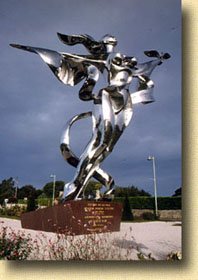 As you near the town, you come upon a colossal winged stainless steel sculpture. This grandiose work by the Chinese artist Yao Yuan was a gift of the Chinese World Peace Foundation for the 60th anniversary of D Day in 2004. The gleaming metallic structure stands out in sharp contrast to the gentle earth tones of the pastoral landscape of the Bessin. As you near the town, you come upon a colossal winged stainless steel sculpture. This grandiose work by the Chinese artist Yao Yuan was a gift of the Chinese World Peace Foundation for the 60th anniversary of D Day in 2004. The gleaming metallic structure stands out in sharp contrast to the gentle earth tones of the pastoral landscape of the Bessin.
Take the road to the right of the statue, pass the church and continue down the street to the main intersection. You are at the center of the town where Rue Aristide Briand, the main shopping street, meets Rue du Docteur Boutrois.
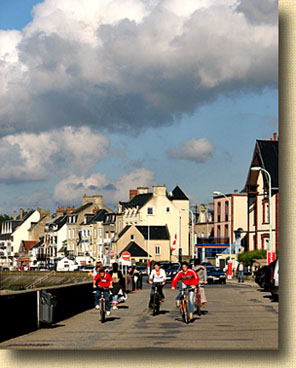
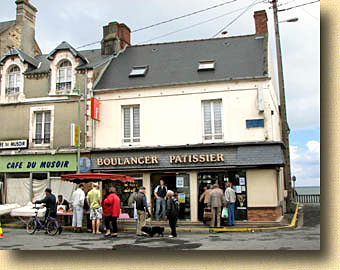 This corner is called "Le Musoir", "the place to chat" in the local patois because the fishermen used to gather here - and chat. Turning right brings you to the sea and the sea front which pedestrians share, although not enthusiastically, with cars and motor bikes. This corner is called "Le Musoir", "the place to chat" in the local patois because the fishermen used to gather here - and chat. Turning right brings you to the sea and the sea front which pedestrians share, although not enthusiastically, with cars and motor bikes.
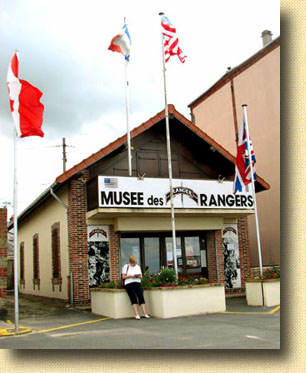
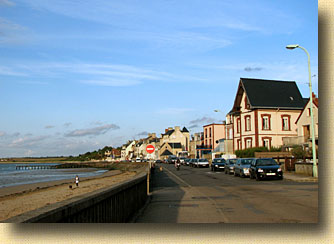 On the seafront promenade which locals call the Perré, summer villas have been freshly restored, exposing their white limestone facades. The old coast guard station has been transformed into the Musee des Rangers, dedicated to the World War II Rangers who took part in the Allied Landings in Normandy on June 6, 1944: those of the 2nd Ranger Battalion who scaled the 100 foot cliffs at the Pointe du Hoc, and those of the 5th and 2nd Ranger Battalions whose bravery and leadership on "Bloody Omaha" earned them the motto "Rangers Lead the way". The veterans of this elite group have a long standing association with Grandcamp. On the seafront promenade which locals call the Perré, summer villas have been freshly restored, exposing their white limestone facades. The old coast guard station has been transformed into the Musee des Rangers, dedicated to the World War II Rangers who took part in the Allied Landings in Normandy on June 6, 1944: those of the 2nd Ranger Battalion who scaled the 100 foot cliffs at the Pointe du Hoc, and those of the 5th and 2nd Ranger Battalions whose bravery and leadership on "Bloody Omaha" earned them the motto "Rangers Lead the way". The veterans of this elite group have a long standing association with Grandcamp.
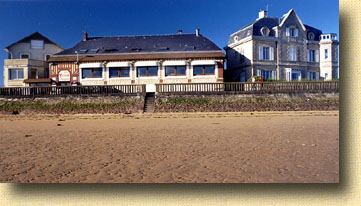 Further on is the Duguesclin, a grand old hotel-restaurant with a second-floor dining room overlooking the sea. It is named for Bertrand Duguesclin, a celebrated 14th century commander of the French armies who chased the English out of France during the Hundred Years War. He was noted for his ugliness and took as his motto: "Le courage donne ce que la beaute refuse" - "Courage gives what beauty refuses". Further on is the Duguesclin, a grand old hotel-restaurant with a second-floor dining room overlooking the sea. It is named for Bertrand Duguesclin, a celebrated 14th century commander of the French armies who chased the English out of France during the Hundred Years War. He was noted for his ugliness and took as his motto: "Le courage donne ce que la beaute refuse" - "Courage gives what beauty refuses".
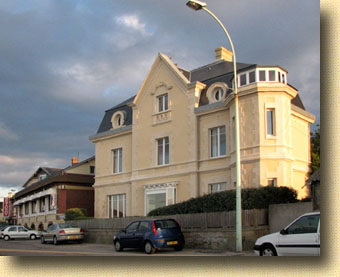 The last villa on your left, the stately Villa Mathieu was the headquarters of the Kriegsmarine, the German navy, during the Second World War. Next to it, at the corner, stands a monument to the heavy bomber crews who lost their lives during the Battle of Normandy. The last villa on your left, the stately Villa Mathieu was the headquarters of the Kriegsmarine, the German navy, during the Second World War. Next to it, at the corner, stands a monument to the heavy bomber crews who lost their lives during the Battle of Normandy.
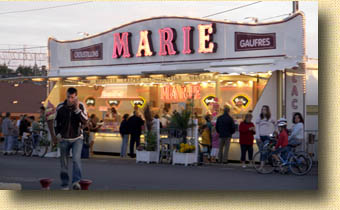 Across the roadway, in the summer, bright neon signs announce a gaming arcade, and a snack stand which offers cotton candy, waffles, crepes, and other deep fried treats. Straight ahead, the sea front ends at the ship channel which leads from the harbor to the sea and is protected by a curving jetty. Across the roadway, in the summer, bright neon signs announce a gaming arcade, and a snack stand which offers cotton candy, waffles, crepes, and other deep fried treats. Straight ahead, the sea front ends at the ship channel which leads from the harbor to the sea and is protected by a curving jetty.
Turn left and leave the car on the quay. The harbor is the hub of the town, buzzing with activity when Grandcamp's fleet of trawlers prepare to set out to sea or when they return, their hulls half submerged in the water from the weight of their cargo.
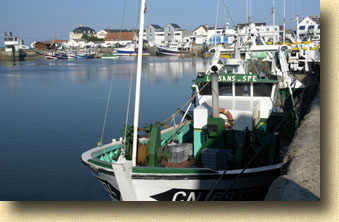 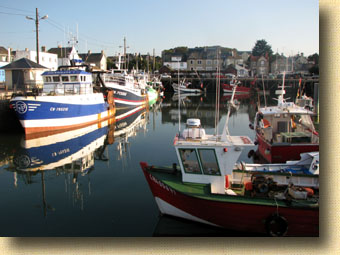
If you are here in the morning and the tide is right, you might get a chance to see the boats come back from their night at sea.
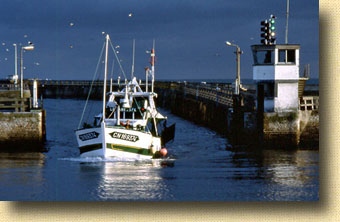 
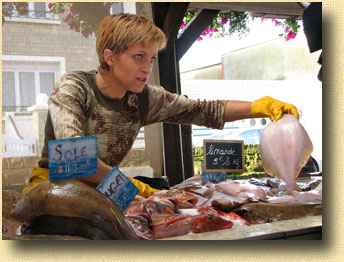 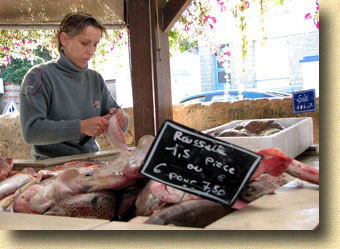
The crews unload their catch, destined either for the wholesale market on the west end of the harbor, or the small covered market where the fishermen's wives and daughters sell turbot, brill, sole, flounder, limande, red snapper, sea bass, mackerel, mussels, lobster, crabs, or in winter, scallops. This is your chance to get some of the freshest and finest sea food anywhere - so fresh, in fact, the fish you eye as you make your selection at the market may jump up in protest.
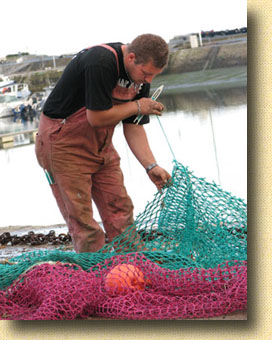 During the day, the ships' crews can often be seen on the harbor making repairs to the ships and equipment. Large colorful nets cover the quays as the crews deftly weave their needles knotting heavy twine to the netting to mend the torn mesh. During the day, the ships' crews can often be seen on the harbor making repairs to the ships and equipment. Large colorful nets cover the quays as the crews deftly weave their needles knotting heavy twine to the netting to mend the torn mesh. 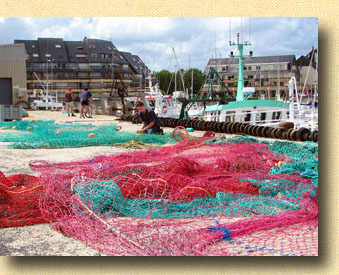
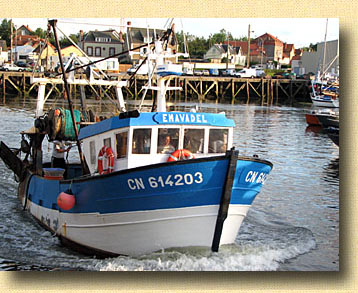
In the evening, Grandcamp's fleet of trawlers sets out to sea. One by one, the colorful ships slip out of the harbor through the narrow channel and out to open water. You watch the ships grow smaller and smaller; then, disappear.
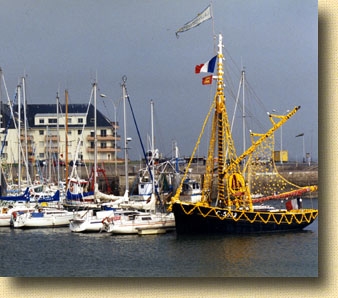 At the north end of the harbor, a sailing ship from a bygone era is berthed at the edge of the pleasure boat marina. The "Grandcopaise" was in service from 1949 to 1988, fishing off the coast of England and in the Bay of Seine. It fell into disrepair and was rebuilt as a replica of a fishing bark of the 1880-1910 period by the Association du Torbouai. This group of volunteers maintains the boat and organizes cruises in the bay. "Torbouai" is patois for Tor Bay, on the south coast of England, where the trawlers from Grandcamp once fished. At the north end of the harbor, a sailing ship from a bygone era is berthed at the edge of the pleasure boat marina. The "Grandcopaise" was in service from 1949 to 1988, fishing off the coast of England and in the Bay of Seine. It fell into disrepair and was rebuilt as a replica of a fishing bark of the 1880-1910 period by the Association du Torbouai. This group of volunteers maintains the boat and organizes cruises in the bay. "Torbouai" is patois for Tor Bay, on the south coast of England, where the trawlers from Grandcamp once fished.

You can find information at the Torbouai's chalet on the northeast side of the harbor. It also serves as a tourist office.
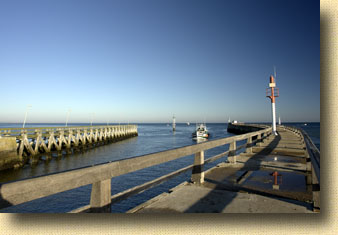 Walk to the end of the jetty. There used to be a lighthouse here, but it has been replaced by a beacon a few feet further out. From here, your view extends from Utah Beach to the west, along the Cotentin peninsula, to the Saint-Marcouf islands to the North. Closer, along the beach, you'll see two bunkers, remains of the Atlantic Wall built by the Germans during World War II with conscripted local men and POWs from the Eastern Front. The larger one replaced an old fort from the XVIIc, part of the coastal defenses during the wars with England. Walk to the end of the jetty. There used to be a lighthouse here, but it has been replaced by a beacon a few feet further out. From here, your view extends from Utah Beach to the west, along the Cotentin peninsula, to the Saint-Marcouf islands to the North. Closer, along the beach, you'll see two bunkers, remains of the Atlantic Wall built by the Germans during World War II with conscripted local men and POWs from the Eastern Front. The larger one replaced an old fort from the XVIIc, part of the coastal defenses during the wars with England.
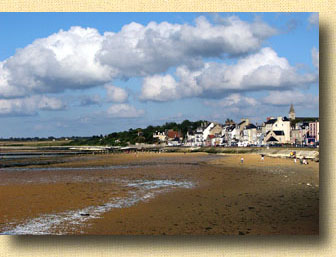 Toward the east, the village of Grandcamp hugs the bay. An old wooden jetty, where the fishing boats used to dock before the harbor was built, juts out from the shore. The church steeple stands on the crest of a hill at the far end of the town. Toward the east, the village of Grandcamp hugs the bay. An old wooden jetty, where the fishing boats used to dock before the harbor was built, juts out from the shore. The church steeple stands on the crest of a hill at the far end of the town.
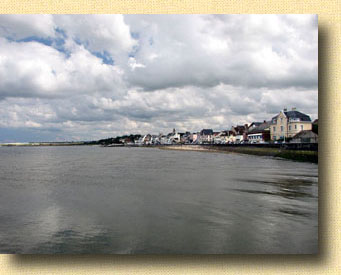
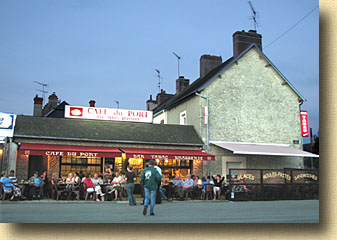
For a drink, stop at the Cafe du Port, a local hangout, or the Bar de La Maree, a favorite of out-of-towners and pleasure-boaters.
 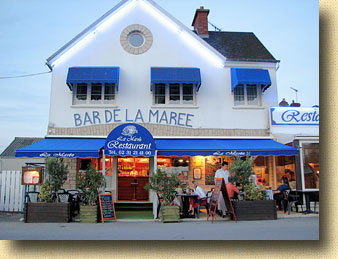
For lunch or dinner, La Maree offers a sophisticated cuisine, specializing in seafood.
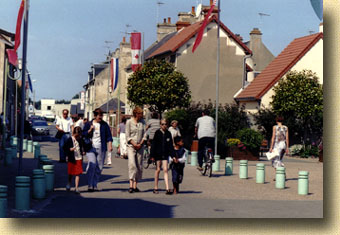 Walk back into town down the main street. The tourist office is located in a small picturesque square, shaded by magnolias. Next to it, is the former Girls Elementary School, a stately limestone building typical of the region. An old granite cider press stands in the middle of the square. Further down the street, you will find the post office, a pharmacy, a small bookstore which sells French and foreign newspapers, and other shops and cafes. Walk back into town down the main street. The tourist office is located in a small picturesque square, shaded by magnolias. Next to it, is the former Girls Elementary School, a stately limestone building typical of the region. An old granite cider press stands in the middle of the square. Further down the street, you will find the post office, a pharmacy, a small bookstore which sells French and foreign newspapers, and other shops and cafes.
As you walk, look up: Dormer windows are often decorated with ornamental stone or woodwork; older houses still have rows of hooks under the roof line, from which fishing nets were hung to dry, and a metal rod over the dormer windows, which held the pulleys with which the fishermen hoisted their gear to and from the attic.
At the town center, Le Musoir, turn right up Rue du Docteur Boutrois, or more familiarly, la Rue des Dames. It will take you to the Place de la Republique with its attractive town hall. At the center of the square stands a monument dedicated to the World War II Army Rangers. 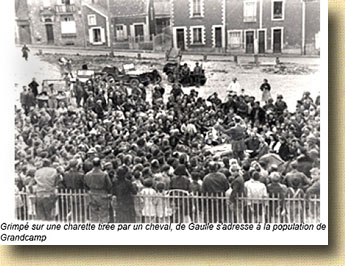 In June 1944, General de Gaulle, leader of the Free French forces, and later President of the Republic, on his first trip to France after D Day, gave a speech on the square to the newly liberated people of Grandcamp. On the 4th of July 1944, General Bradley led the ceremonies here commemorating the American Independence Day while local school boys sang the American national anthem. In June 1944, General de Gaulle, leader of the Free French forces, and later President of the Republic, on his first trip to France after D Day, gave a speech on the square to the newly liberated people of Grandcamp. On the 4th of July 1944, General Bradley led the ceremonies here commemorating the American Independence Day while local school boys sang the American national anthem.
Walk back to the Musoir and continue to the seafront. On your right, the old wooden jetty still stands where the fishing boats unloaded their catch before the present harbor was built .
 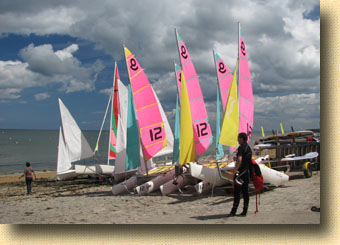
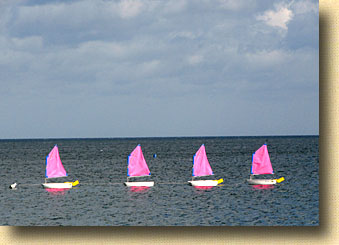
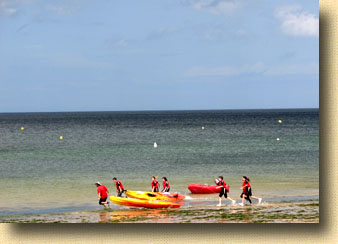
The boat ramp which once also served as the fish market is now used by the sailing school. Return to the harbor along the Perré.
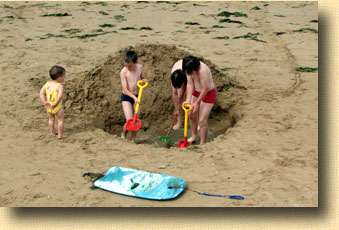 The promenade offers ever-changing views of a vast sea and sky. The beach below, at low tide, is a good place to build a sand castle, fly a kite, or catch a game of volleyball or petanque. The promenade offers ever-changing views of a vast sea and sky. The beach below, at low tide, is a good place to build a sand castle, fly a kite, or catch a game of volleyball or petanque.

Early in the morning you can often catch a glimpse of prize winning trotters training on the beach.
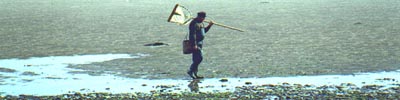
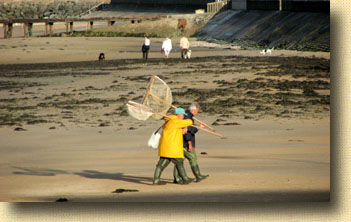 Further out, among the low lying rocks, shrimp are caught in large handheld nets called boutous. But as the waters rise, and the sands begin to disappear, swimming and boating become preferred activities. Further out, among the low lying rocks, shrimp are caught in large handheld nets called boutous. But as the waters rise, and the sands begin to disappear, swimming and boating become preferred activities.
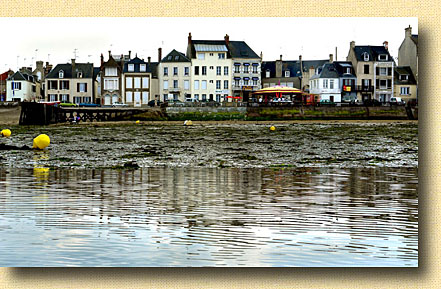
Take a moment to walk down to the beach for a sea view of the town before returning to the harbor.
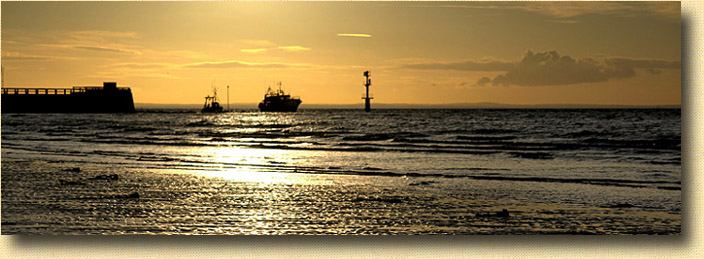
Stay for diner, and do not miss the sunset.
|